How to Interpret Your Personal Report
Your personal report shows your profile across interests, self-assessed competencies and values and compares it with different reference groups. The following information will help you understand the visualisations and use the results for your own reflection.
Importantly, higher or lower scores are not automatically better or worse. What matters is the pattern of your profile: Where are your main areas of emphasis? Where do you see similarities or differences compared with a reference group?
Structure of the Personal Report
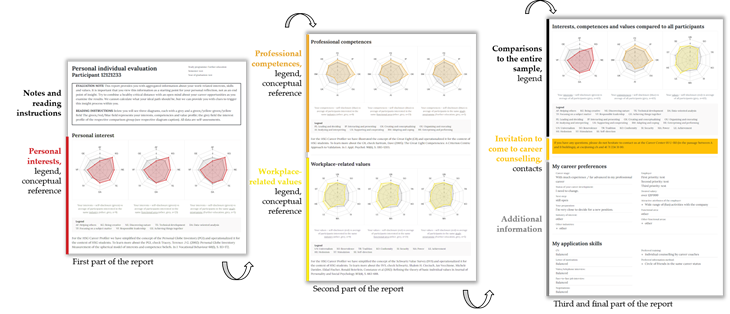
Your personal report consists of three parts:
1. Your Profile
The first page provides an overview of your interests, self-assessed competencies and values.
2. Your Profile in Comparison
The second and third pages compare your profile with different reference groups – for example, people from your study programme or people interested in the same industry or functional area.
3. Your Responses and Further Support
At the end, you will find further information from the survey as well as information about the UZH Career Services.
How to Read Your Personal Report
The key elements of your personal report are the radar charts. They show your profile and allow you to compare it with different reference groups. The aim is not to achieve the highest possible scores, but to look at the pattern of your profile: Where are your areas of emphasis? Where do you see similarities or differences compared with a reference group?
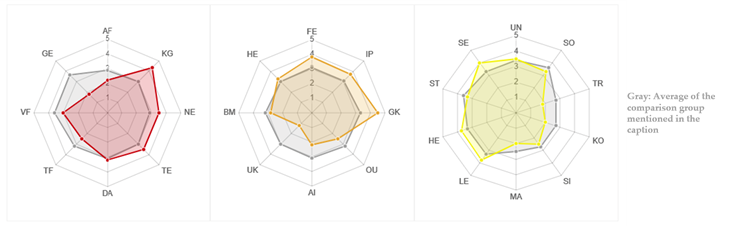
Your responses form the basis of the coloured profile shown in each chart (green, blue or red). The grey profile in the background represents the mean scores of the respective reference group. The scale ranges from 1 to 5, corresponding to the five-point scale used in the survey.
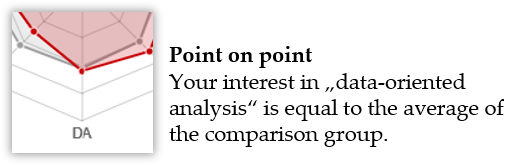
1. Similar Score
If your score on a factor is approximately the same as the score of the reference group, the values are similarly pronounced.
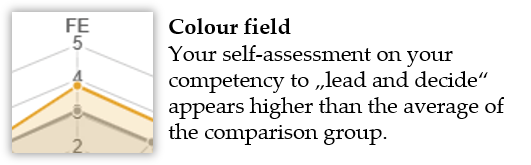
2. Your Score is Higher
If your score on a factor lies outside the reference group's score, you have rated yourself higher on this factor than the reference group on average.
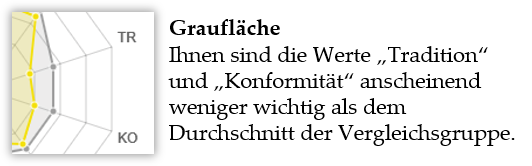
3. Your Score is Lower
If your score on a factor lies inside the reference group's score, you have rated yourself lower on this factor than the reference group on average.
Important: Higher or lower does not mean better or worse. The reference values help you put your profile into perspective. What is particularly interesting is how the different factors relate to each other and the overall pattern they form.
Examples of Profile Shapes
The following examples illustrate different patterns that may appear in a profile. They are intended as illustrations and do not represent fixed personality types or categories. Your own profile may combine elements of different patterns.
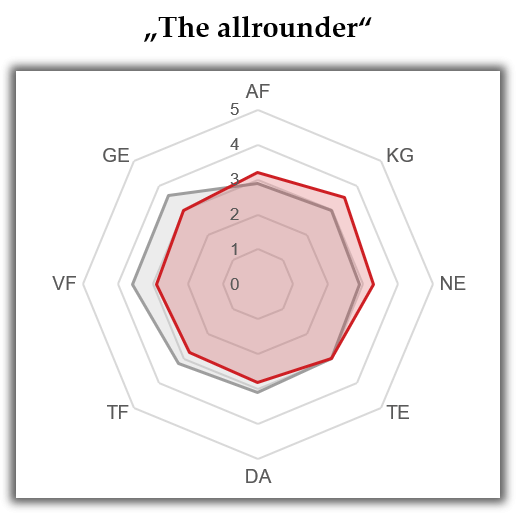
"The all-rounder"
A relatively balanced profile shows similar scores across the different factors. No single factor stands out particularly strongly. This may indicate that several interests, competencies or values are similarly important or similarly pronounced in your self-assessment.
For reflection, it can be useful to consider what this combination means for you.
Which factors are similarly pronounced in my profile – and what does this combination mean for me?
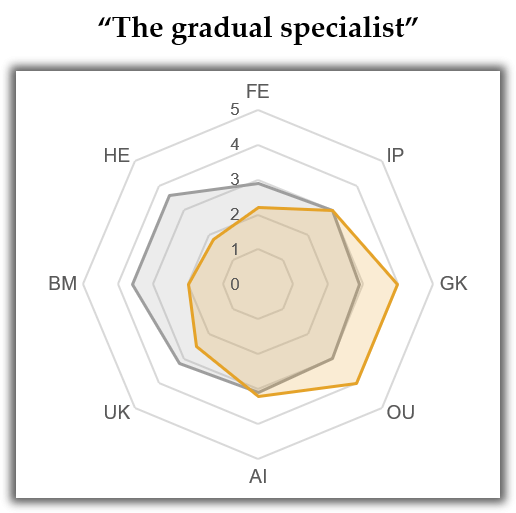
"The gradual specialist" or "The Profiled"
In a more pronounced profile, some factors stand out more clearly than others. These differences can provide clues as to which interests, self-assessed competencies or values are particularly characteristic of your profile.
For reflection, it can be useful to consider what these distinctive features mean for your career orientation.
Which factors stand out in my profile – and what does this combination tell me about my profile?
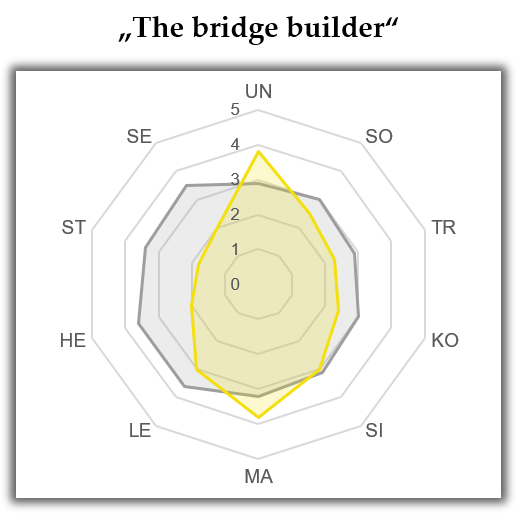
"The bridge builder"
In this pattern, two rather contrasting factors stand out at the same time, while other factors are less pronounced. In the example, these are Social Orientation and Achievement. Such a profile can be interesting because it highlights preferences that may initially appear different but can nevertheless be combined in a professional environment.
For reflection, it can be useful to consider how these different aspects of your profile can be combined.
How can different aspects of my profile be combined in activities or work environments?